
MCQs that test thinking, not luck
Multiple choice questions are only as good as their options. Practical rules for writing stems and distractors that make students think before they circle.
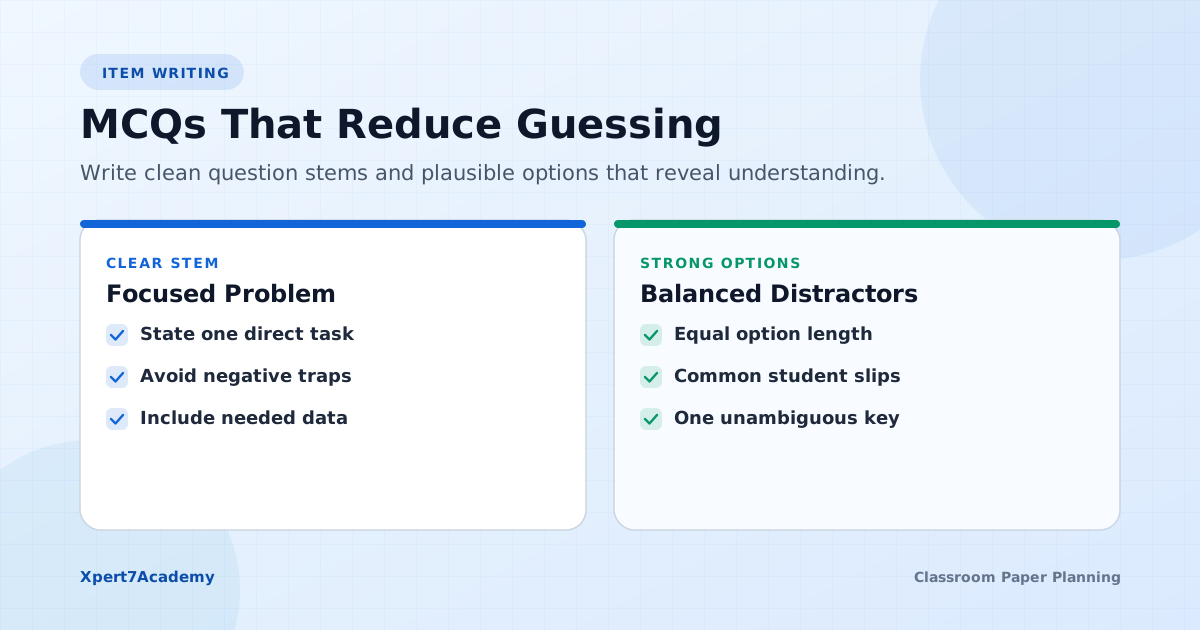
A weak MCQ can be answered by a student who has never opened the book, the odd option out, the longest sentence, the 'all of the above'. A strong MCQ makes every option plausible to someone who half-knows the topic. The difference is entirely in how the options are written.
Put the thinking in the stem
The question line should contain the whole problem: 'Which instrument measures atmospheric pressure?' rather than 'Atmospheric pressure:'. A complete stem lets students answer in their head before reading the options, which is exactly the understanding you want to check.
- One clear question per item, no 'and' chaining two facts.
- Avoid negatives; if you must use one, bold the word NOT.
- Keep the stem at one line where possible.
Make every distractor a real misconception
The best wrong answers are the ones students actually believe. Collect them while marking: the unit confusion, the formula used backwards, the similar-sounding term. An option set built from your own class's mistakes will separate genuine understanding from pattern-spotting far better than three obviously silly options.
- Note the three most common wrong answers in your marking.
- Turn each into an option for the next test.
- Retire distractors that nobody ever picks.
Keep the options level
Students notice structure faster than content. If the correct answer is always the longest or the only one with a full stop, the test rewards test-taking, not knowledge. Match option lengths, vary the position of the right answer across the paper, and keep grammar parallel, all nouns or all sentences, never a mix.
- Similar length for all four options.
- No 'all/none of the above' unless genuinely sometimes-true.
- Correct answers spread evenly between a, b, c and d.
Use numbers where the subject allows it
In maths, physics and chemistry, make distractors from the process, not from thin air. A sign error, a forgotten unit conversion, a formula used with the wrong value, each wrong option then tells you which step the student got wrong. That diagnostic value is something a written answer cannot match at scale.
Check the whole set before printing
Read the options column top to bottom: can a student who knows nothing find the answer by elimination? Can a student who knows the topic defend every choice? Fix the set once, and it serves you for years, good MCQs are the most reusable questions you own.
In Xpert7Academy, use topic browsing and manual question selection when you want to inspect the stem and all options before keeping an MCQ.
Start with a small paper.
Try the full Automated Test Generation free for 10 days after signup.
Saving and customization are included in the demo. Continue afterwards with Rs. 3,000 for 3 months (orig. Rs. 4,500), Rs. 5,000 for 6 months (orig. Rs. 7,000), or Rs. 7,000 for 1 year Full Session (orig. Rs. 10,000).
Before choosing questions, check your section marks with the free planner. It accounts for optional questions as well as compulsory ones.