
Planning school test papers in Islamabad and Rawalpindi
Choose Federal or Punjab textbook content by school affiliation, then plan chapter tests, send-ups and printable papers for Islamabad and Rawalpindi classrooms.
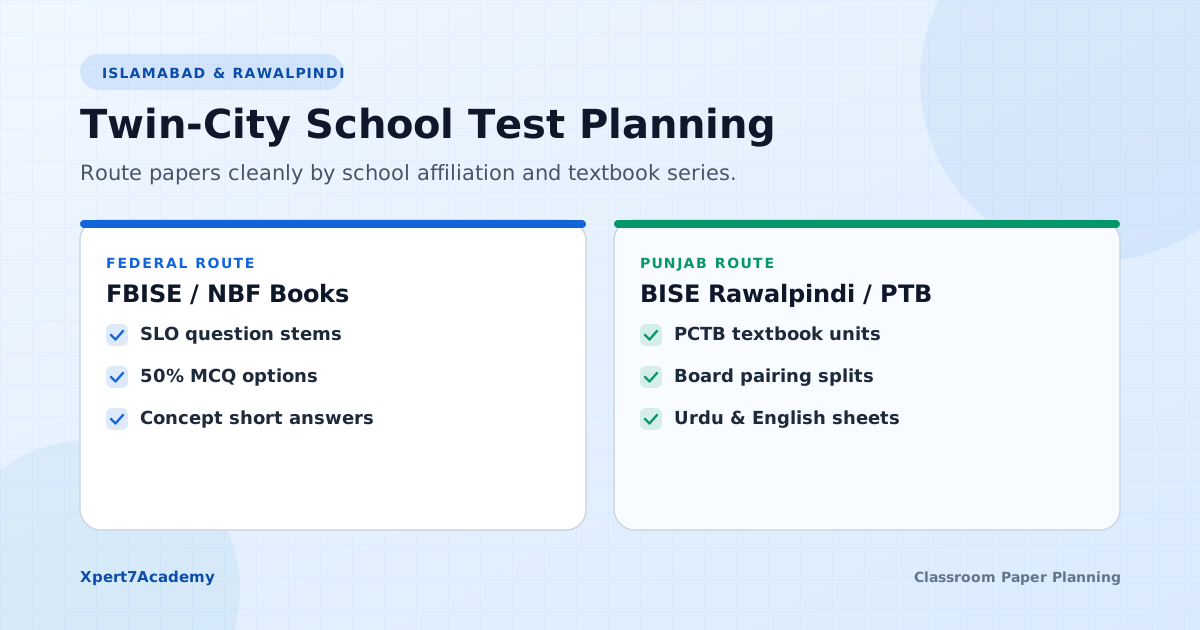
Two teaching groups in the same city may need different books and different examination references. That matters when an academy in Islamabad or Rawalpindi prepares tests for more than one school. Start with each group’s affiliation and textbook, then plan the assessment. A city label, a familiar subject name or a forwarded paper should not make that decision for you.
Confirm whether the group follows FBISE or another board
FBISE is the Federal Board of Intermediate and Secondary Education, based in Islamabad. BISE Rawalpindi is a separate examination authority. Confirm the student’s or institution’s actual affiliation using school records and the relevant official board information. Do not assume every Rawalpindi school is Federal, or that its examination material follows the same rules as a neighbouring school.
For an FBISE group, keep the official Federal model-paper and assessment-framework resources beside the draft. For a BISE Rawalpindi group, consult that board’s applicable resources, including its official past-paper directory. Past papers are examples of earlier exams; check the current requirements separately.
Choose the book content independently of the city
In Xpert7Academy, inspect Federal books for Classes 6 to 12 when they match the material your group studies. If the group uses Punjab textbook content, inspect the PTB directory and compare the actual edition and chapters. Primary and middle classes may instead use AFAQ SNC or Oxford SNC books listed in the complete curriculum directory.
Write the book title, class, edition and taught chapters at the top of your planning notes. Subject names alone are too broad for this job. An academy teaching two groups should keep separate scopes when the books differ, even if both groups call the topic “Algebra” or “Motion”.
Keep lesson checks and send-ups as separate plans
For a short chapter-wise test, choose only the topics taught to that group and allow enough reading and working time. For a send-up or board-style mock, use the applicable official structure and outcome coverage as a separate planning brief. A longer chapter quiz is not automatically a complete mock exam.
A useful brief says what the assessment is for, which book it uses, what students must attempt and how you will mark the responses. Share it with the subject teacher before collecting questions. If two teachers will prepare different sections, settle the total and choice rules first so the paper does not grow beyond the agreed scope.
Use one consistent review process across your teaching groups
Keep a simple record for each group: affiliation, class, book, taught scope, assessment purpose, medium and reviewer. Then choose manual or balanced random selection inside the studio. Manual selection is useful when a coordinator needs to review specific questions; a random draft still needs the same subject check.
For Federal mocks, follow the FBISE model-paper checking guide. Record any question whose language, diagram or stored answer needs attention and resolve it before printing. Reusing a saved paper should include a new scope check when the group or textbook changes.
Agree on the medium and the final printing copy
Choose English, Urdu or dual medium where the stored content supports it. Use the printing guide to check joined letters, notation and page breaks. If a group uses a separate answer sheet, put that instruction on the paper; if it writes on the sheet, allow realistic working space.
Before making copies, open the saved PDF and check the group name, subject, total marks and attempt instructions. Remove any unintended answer display from the student copy. Print one sample at the intended size and inspect diagrams and the final lines on each page. Give the printer one clearly named final file to avoid distributing an earlier draft.
Check the available content before arranging a subscription
Xpert7Academy is an online tool that teachers in Islamabad and Rawalpindi can use through the browser. Browse the Federal paper-making hub and public directories before signing up. A new account has 10 days of full studio access to inspect questions, customize, save and print a sample.
After the demo, paid access costs Rs. 3,000 for 3 months (orig. Rs. 4,500), Rs. 5,000 for 6 months (orig. Rs. 7,000), or Rs. 7,000 for 1 year Full Session (orig. Rs. 10,000). Activation is arranged with support on WhatsApp. If several teachers need accounts, confirm that arrangement before purchasing; a standard subscription is not a published unlimited-seat licence. Paid access continues the tools, but does not change the underlying book content or certify an examination pattern.
Start with a small paper.
Try the full Automated Test Generation free for 10 days after signup.
Saving and customization are included in the demo. Continue afterwards with Rs. 3,000 for 3 months (orig. Rs. 4,500), Rs. 5,000 for 6 months (orig. Rs. 7,000), or Rs. 7,000 for 1 year Full Session (orig. Rs. 10,000).
Before choosing questions, check your section marks with the free planner. It accounts for optional questions as well as compulsory ones.