
FBISE Model Papers & Assessment Framework Guide for Teachers
Find official FBISE SSC and HSSC model papers, check the applicable assessment framework and turn its requirements into a reviewed classroom practice test.
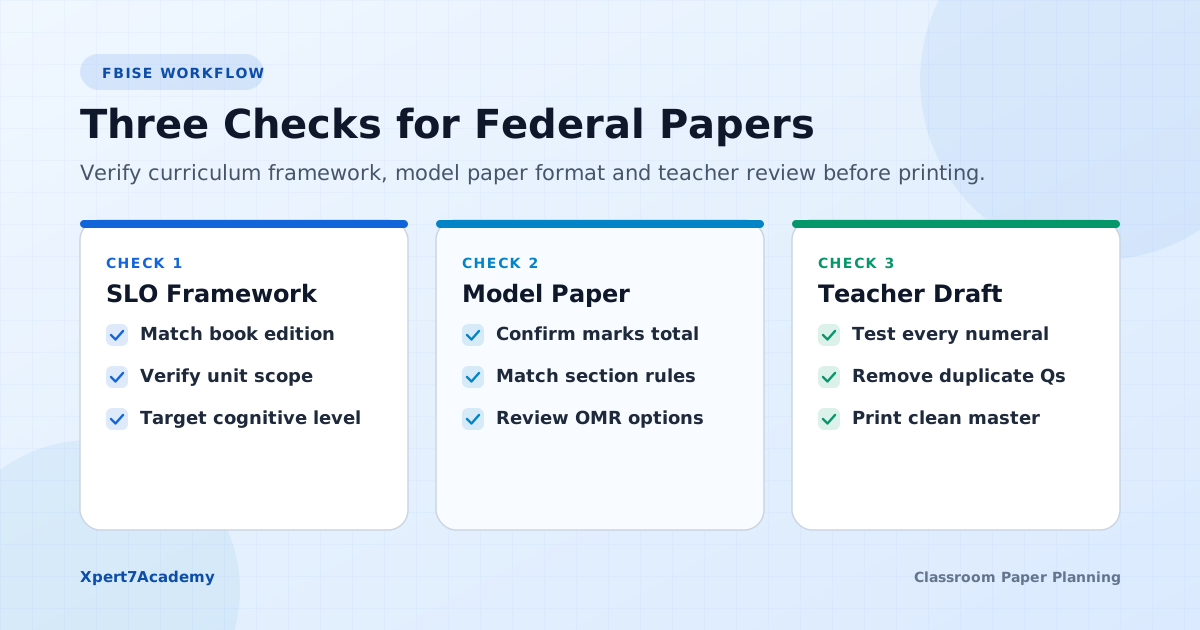
You have found an FBISE model paper, but another copy has a different section structure. Which one should you use? Before counting MCQs or copying a heading, check the subject, examination level, curriculum and scheme of studies. The official resource page contains several document versions. A useful practice test starts with the version that applies to your students, then a separate review of the questions you select.
Find the official model paper for the right examination level
Start at the FBISE assessment framework and model question papers page. It separates SSC and HSSC resources and lists documents by subject and class. SSC-I is Class 9, SSC-II is Class 10, HSSC-I is Class 11 and HSSC-II is Class 12. Choose the correct level before opening a subject file.
Read the labels around the download, not just the PDF filename. Check which curriculum and scheme of studies it refers to, whether it covers theory or practical work, and whether a later applicable notification changes it. Save that reference with your draft. A resource shown on the official site can still belong to a different cohort.
Keep model papers, past papers and frameworks separate
A model paper illustrates an assessment structure and example tasks. A past paper records an examination that has already taken place. An assessment framework describes what to assess and how the assessment is organised. They answer different questions. An old examination paper can be useful for practice without establishing the requirements of your next assessment.
For earlier examination questions, use the official FBISE old question papers directory. For a classroom paper, keep the current framework and model beside you while selecting questions. Our board-pattern and classroom-test guide helps decide whether you are preparing a focused lesson check or a board-style mock.
Check the learning outcome, not only the chapter title
SLO means student learning outcome: the knowledge or action the learner is expected to demonstrate. When your applicable framework distinguishes formative and summative outcomes, read those classifications before choosing material for an examination-style mock. Classroom learning can still include formative work. Do not turn an exam-scope distinction into a reason to stop teaching that work.
The IBCC model assessment framework overview explains the wider assessment resources, including outcomes, cognitive levels and tables of specification. For your actual paper, use the applicable FBISE subject document. A question that mentions the right topic can still ask for the wrong action: naming a relationship is different from applying it to unfamiliar information.
Write a small review sheet before selecting questions
Use one row per intended question or task. Record the outcome you want to check, the required response, the marks, the question you selected and the official source you checked. Leave a clear gap when you have not found a suitable question. That gap is more useful than quietly inserting an unrelated item to complete a section.
For a teacher-designed calculation task, for example, note whether you expect a recalled formula, a substitution, a worked method or an explanation of the result. These are planning examples, not a claim about an official subject distribution. Set the required quantity and choice rules from the applicable document when building a board-style mock.
Check attempted marks with the paper marks planner. Offered questions and attempted questions can differ. Your printed instructions, section totals and marking notes should agree about which responses count.
Use Federal book selection to assemble the draft
Xpert7Academy’s Federal paper generator and coverage guide leads to the available Classes 6 to 12. For SSC and HSSC preparation, inspect your exact book in the relevant Class 9, 10, 11 or 12 directory. Then follow the Federal practice-paper workflow to choose chapters, topics and question types.
Use manual question selection when you need to compare an individual question with your review sheet. Balanced random selection can distribute a draft across eligible topics, but it does not automatically tag or certify SLO coverage, cognitive levels or the official model-paper pattern. Keep those checks in your own review.
Review the student copy and the marking information
Read the draft as a student would. Check command words, compulsory work, choices, diagrams, units and enough writing space. Review stored answer keys independently; an available question does not guarantee a complete or correct worked solution. Ask a subject colleague to review any item you cannot confidently mark.
Finally, inspect every PDF page using the English and Urdu printing checklist. New accounts have 10 days of full studio access, including saving and customization, to try this workflow. Keep the output labelled as teacher-prepared practice. Xpert7Academy is independent of FBISE and does not certify a draft as an official model paper.
Start with a small paper.
Try the full Automated Test Generation free for 10 days after signup.
Saving and customization are included in the demo. Continue afterwards with Rs. 3,000 for 3 months (orig. Rs. 4,500), Rs. 5,000 for 6 months (orig. Rs. 7,000), or Rs. 7,000 for 1 year Full Session (orig. Rs. 10,000).
Before choosing questions, check your section marks with the free planner. It accounts for optional questions as well as compulsory ones.